
Medication Errors in the Clinical Setting
Medication errors are one of the most common mistakes made in the hospital and clinics and to fully understand why and when they occur you need to understand the process that gets a medication to a patient. There are several steps and each step provides one or more opportunities for harm to the patient:
Order
When a patient has a symptom or a condition that necessitates a medication for treatment, the first thing that must occur is a doctor must give an order to the nurse. The order may be written or verbal:
A written order may be misread due to poor handwriting or an improper abbreviation. For example “MS” is the abbreviation Morphine Sulfate, a narcotic pain reliever; but can be confused for Magnesium Sulfate, a mineral that is used for seizures, labor cessation and cardiac arrhythmias.
A verbal order may be misunderstood due to a breakdown in communication. The standard of care is for the nurse to “read back” a verbal order after she/he has written it down. The documentation should reflect that this occurred with the abbreviation “RBVO” or “RBTO” (read back verbal/telephone order).
The order itself must be appropriate for the patient in its dose, method of administration and with consideration for allergies, conditions and interactions with other medications: It is the responsibility of both the nurse and the doctor to ensure that the order is appropriate for the patient and that it is not contraindicated.
It is not uncommon for an allergy to be omitted from a patient’s chart. This is one benefit of electronic charting; the allergies are forwarded from visit to visit automatically. Even so, the allergy list should be confirmed with the patient upon admission and the chart needs to be reviewed by both the doctor and the nurse before ordering or administering a drug.
Many medication dosages are weight-based, so the weight of the patient needs to be accurate on the chart. Some medications are only given intravenously and others are only given orally. Both of these methods can be a liquid form of the medication and this presents another possibility for a medication error both when the order is given and when the medication is administered.
Administration
When a nurse administers a medication, it is his/her responsibility to determine the safety of the medication for that patient. The first step is to be sure the order is appropriate, as detailed above; then the nurse ensures the medication is drawn up appropriately. This involves ensuring that the right drug is pulled out of the cart, that the form of the drug is appropriate and that the correct dosage is measured. These are all areas in which errors commonly occur. There are also certain drugs that are so high risk that they are required to be check by two nurses, such as insulin.
Finally, there is a checklist that occurs at the bedside:
The “5 R’s” is a tool developed to avoid medication administration errors.
Each “R” represents a place where an error is likely to occur:
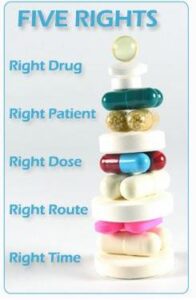
1. Does the medication being given match the order? Check the label on the package to the order.
2. Is the medication being given to the right patient? Check the armband.
3. Does the dosage match the order? Confirm both the amount (i.e. 50) and the units (i.e. mg).
4. Is the medication being given according to the order? Confirm the route on the order (i.e. IV, oral)
5. Is the medication being given at the right time?
Summary
As you can see, there are many areas in which a medication error can occur; which is why it is one of the most common areas of medical malpractice. Many errors do not result in any harm to the patient, but some errors can be excruciatingly painful, life-threatening, or even fatal. There are many guidelines issued to prevent errors in the clinical setting. The Joint Commission (formerly JCAHO) provides several that can be reviewed here: http://bit.ly/JCAHO_mederrors.
September’s On-demand Webinars
Long Term Effects of Traumatic Brain Injury: Forensic Implications- Click here to register
The ABC’s of BFT: Abrasions, Bruises, and Contusions Demystified- Click here to register
Evaluating Strangulation Evidence from a Medical Perspective- Click here to register
Pediatric Strangulation: Not Just “Little Adults”- Click here to register
Don’t miss our newsletter! Topics covered are:
Assault / Trauma
DUI / General Medical
Child & Elder Abuse / Neglect
Mental Health / Toxicology
Sign up here.